Digital transformation is often described as a large-company project: sizeable budgets, dedicated IT teams, and multi-year programs. That picture overlooks the places where technology can have an even more immediate impact. In a small business, every repeated data entry, missed call, and late handoff consumes a visible part of someone’s working day.
L’ami du Pain, an artisan bakery in La Rochelle, took a different route. The goal was never to “do tech” for its own sake. It was to solve ordinary operational problems: accept orders without losing information, aggregate quantities for the bakehouse, track preparation, organize deliveries, and keep customers informed. The result is a business system designed around real work, rather than work redesigned around software.
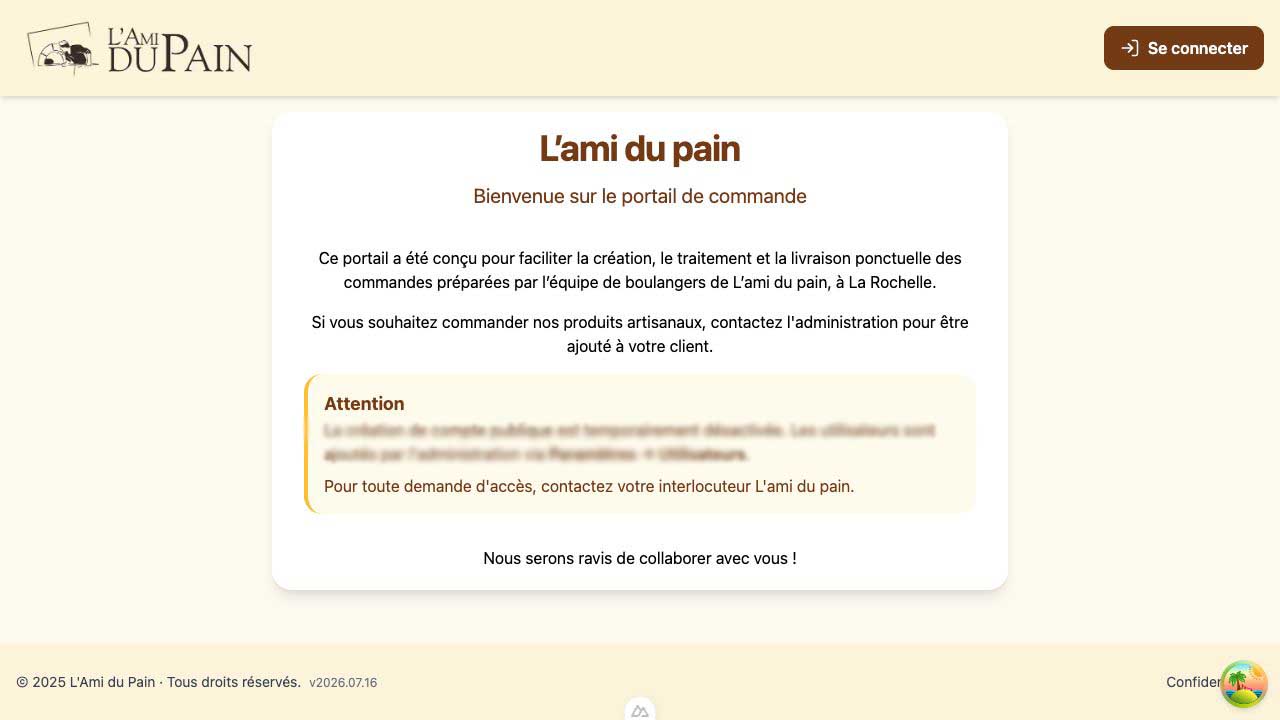
The portal and operational screens below come from the current version. Data that could identify customers has been masked.
The hidden cost of small frictions
In an artisan B2B operation, an order may arrive by phone, message, email, or a face-to-face conversation. Customers value that flexibility, but it transfers complexity to the team. Someone has to understand the request, check the date, identify a product hidden behind a nickname, copy the quantities, alert production to a change, update the delivery note, and confirm the result.
Each step may take only a few minutes. Repeated across dozens of orders every week, it becomes a substantial workload. The larger issue is fragmentation. One order exists across several conversations, spreadsheets, and human memories. A late correction may not reach the right colleague. One person’s absence can make important context temporarily unavailable.
The project’s first achievement was therefore to establish a shared source of truth. An order is no longer a message that must be interpreted several times. It is structured data connected to a customer, delivery date, products, quantities, delivery method, and status.
One flow from order to delivery
The portal gives each role the view it actually needs. Customers see their frequent products, browse the catalogue, select an allowed delivery date, and review active or past orders. Repeating needs can be saved as standing orders. Opening hours, exceptional closures, lead times, and delivery conditions are built into the flow. A rule is applied at the right moment instead of being stored in one person’s memory.
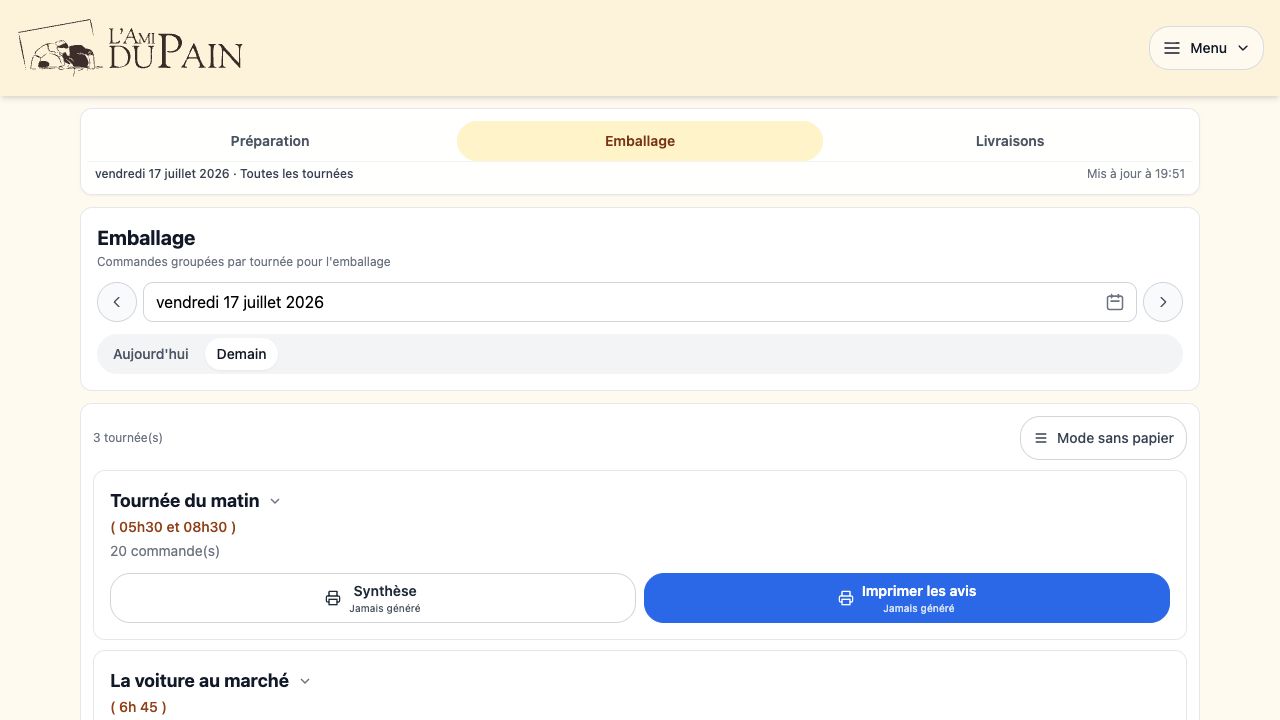
For the internal team, orders are centralized and grouped by date, time slot, and status. A change no longer triggers several rounds of retyping. It becomes visible in the same workflow for preparation, packing, and delivery.
This is no longer a demonstration flow: it now processes more than 1,000 orders each month, representing approximately 4,000 to 5,000 product lines. At that scale, cut-off rules, late corrections, and production aggregation are tested and measured in real working conditions.
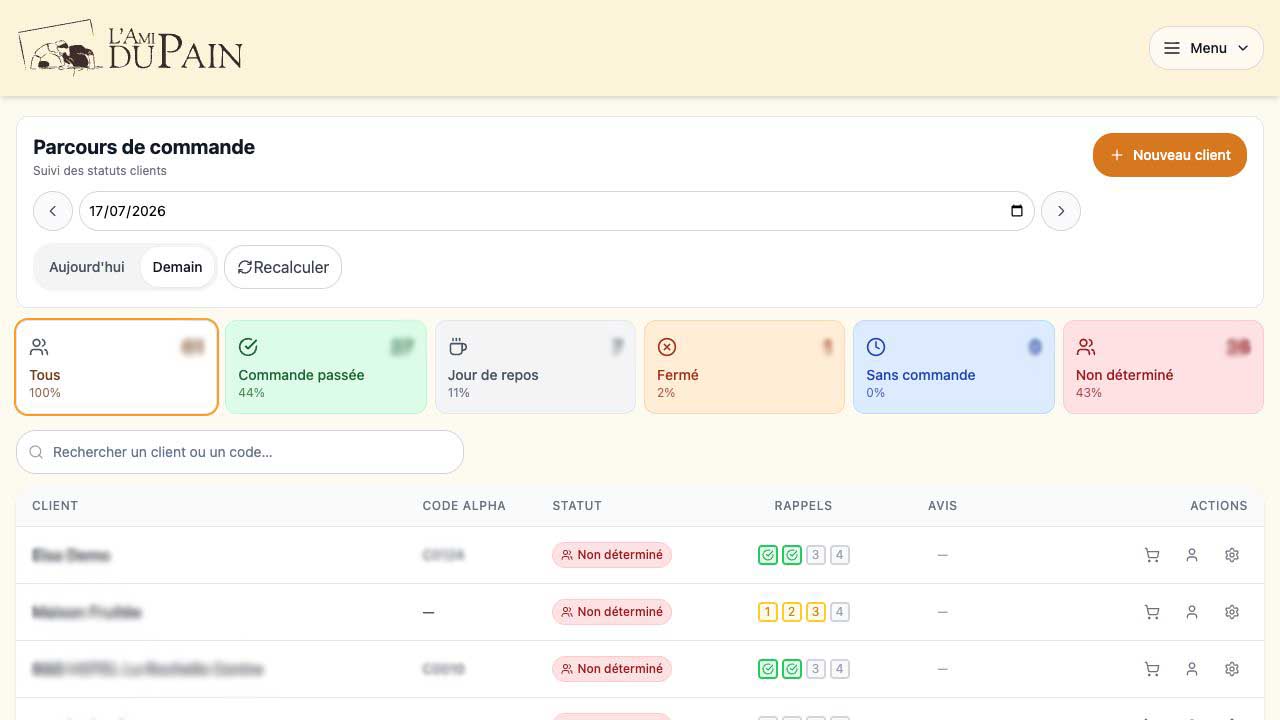
A real capture of the daily customer-status workflow.
The largest gain appears when quantities are aggregated. The bakehouse should not have to read twenty-four separate orders to calculate how many baguettes, specialty loaves, or pastries to make. The system groups requirements by product while preserving customer-level detail. The team can immediately see what remains to prepare, what has been packed, and which delivery run leaves first.
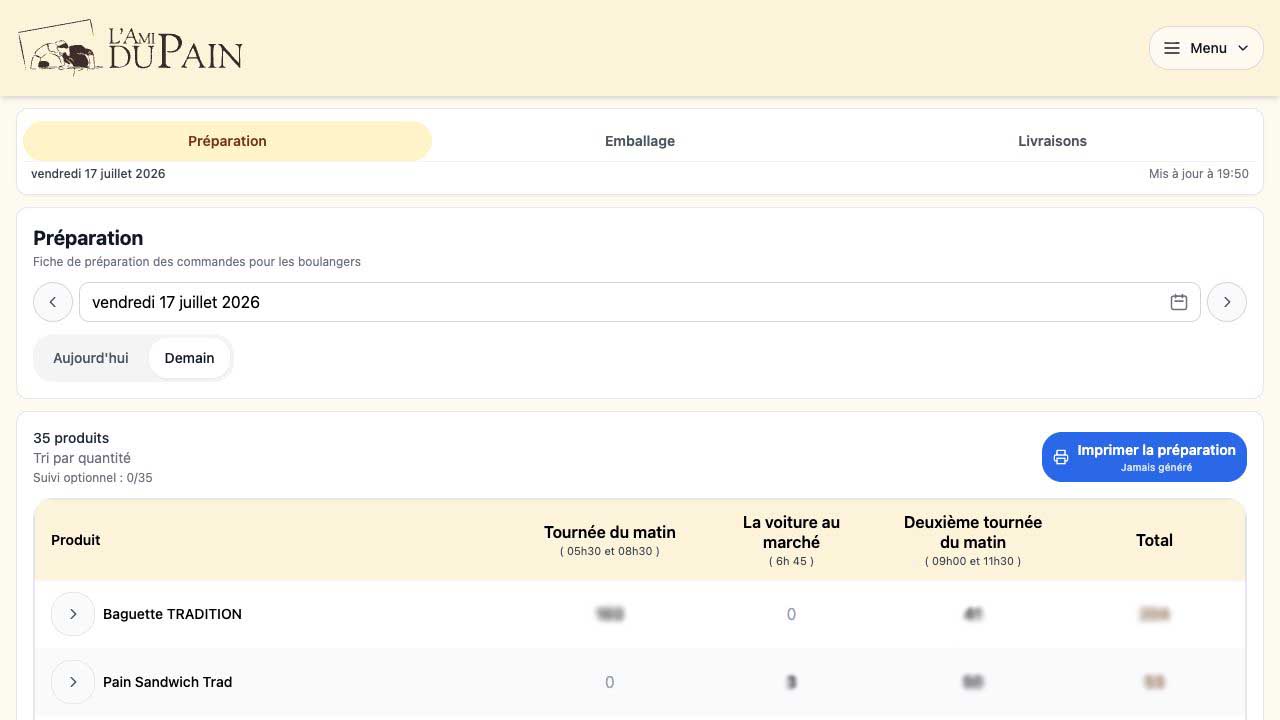
A shared view removes parallel calculations and makes priorities explicit.
At the end of the workflow, delivery notes and PDF documents are generated from the same information. Drivers can follow deliveries, mark an order as delivered, and return real-world status to the team. The customer record then contains a coherent history, useful both for answering a question and preparing the next order.
AI as a business shortcut, not an autopilot
The AI assistant is the most visible part of the system, but it does not replace either business software or human judgment. Its purpose is to shorten the distance between natural language and the structure expected by the application.
An operator can write: “Next week: 20 traditional baguettes and 8 sliced wholemeal loaves on Monday, 24 traditional on Tuesday, then the same as Monday on Thursday.” The assistant identifies the dates, matches everyday wording to catalogue items, considers the customer’s frequent products, and prepares several orders. Before anything is written, it presents a recap and asks for confirmation. If the request is ambiguous, it asks a clarifying question.
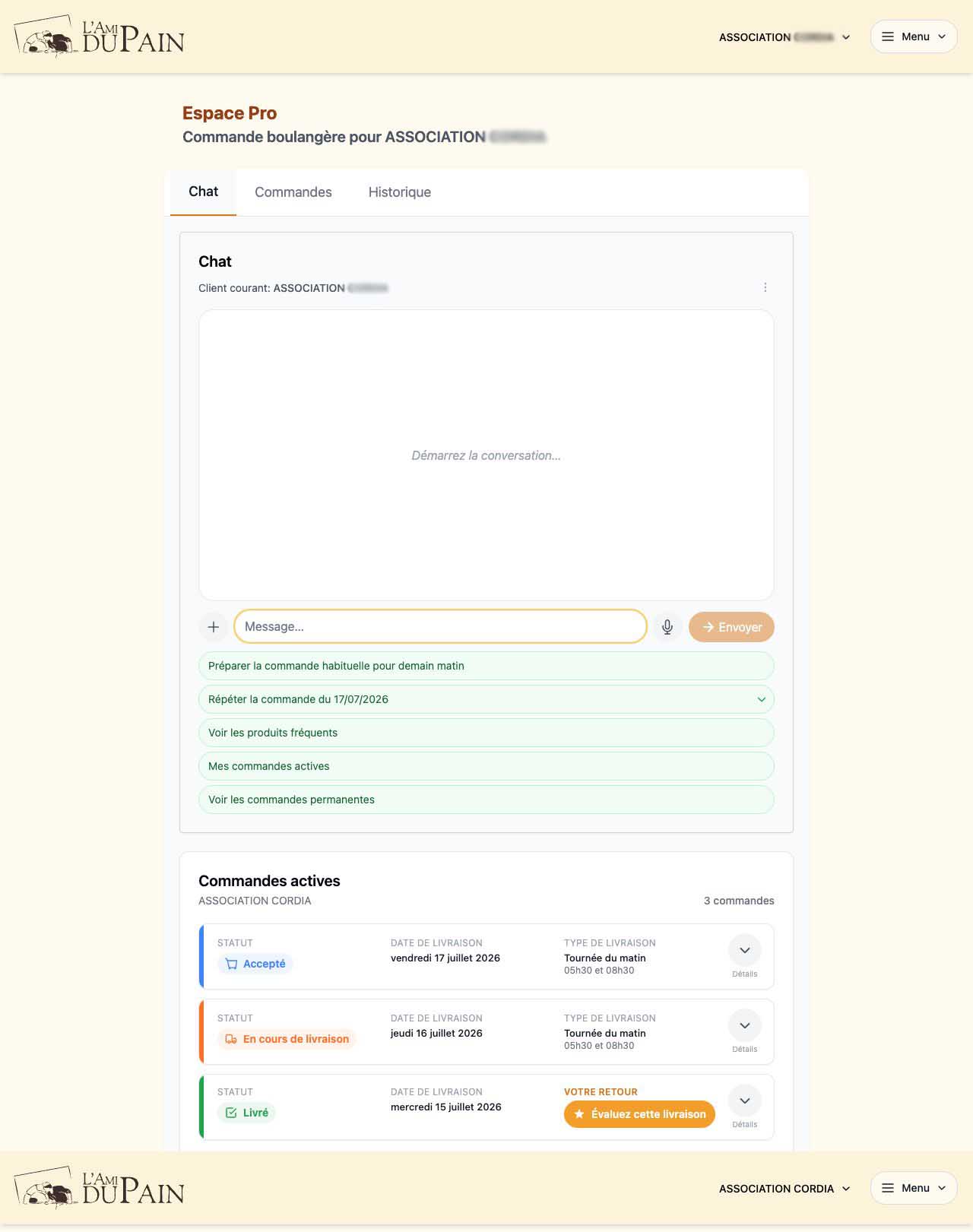
AI creates a structured proposal; the user retains final approval.
That design choice matters. Useful AI in a small business must understand its limits. It works with the actual catalogue, permissions, and operating rules. It keeps a conversation history, can learn recurring expressions, and synchronizes the exchange between devices. But a suggestion is not silently turned into an order. Recap, confirmation, and auditability are part of the product.
The value goes beyond the “chatbot” effect. AI absorbs variation in language: internal abbreviations, approximate product names, or a full week’s order written in one paragraph. It helps people who know the business perfectly but do not want to work through a long sequence of forms. In that sense, the technology adapts to the team’s vocabulary.
A PWA for wherever work happens
A small company cannot assume that everybody works at a modern desktop computer. Orders are checked from a kitchen, a personal phone, the counter, or a vehicle. The web application was therefore built responsively and delivered as a PWA, or Progressive Web App, which can be installed directly from a browser.
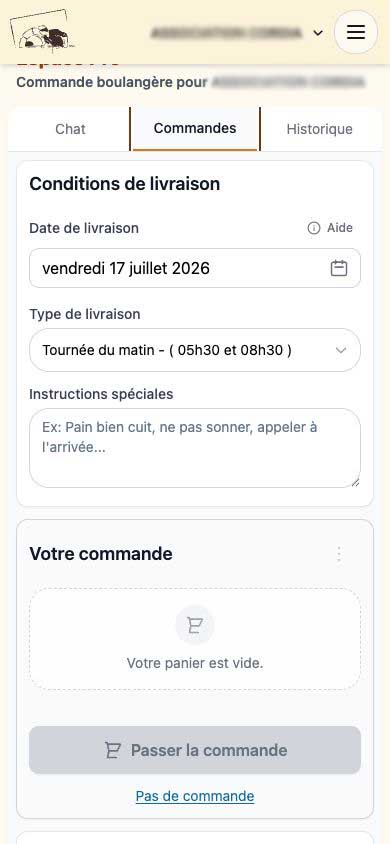
The same workflow works on a small screen, with touch-friendly actions.
The PWA offers an app-like experience: a home-screen icon, standalone display, automatic updates, and planned behavior when connectivity is poor. The basket and other useful states are protected against interruptions. This delivers a coherent mobile experience quickly, without immediately requiring users to install software through an app store.
Dedicated native iOS and Android applications are a future development path, particularly for deeper delivery workflows, notifications, and phone-specific features. They are not presented as already delivered. Today, the operational mobile foundation is the responsive PWA. This staged approach prevents a small business from funding several parallel products before usage genuinely requires them.
Notifications should support the process
Centralization does not mean that everybody must constantly watch a dashboard. The system includes a notification service that can distribute useful events by email, push notification, and Telegram. An order confirmation, a modification, a reminder, or a status change can reach the right person through the channel they normally use.
Telegram is especially practical for short, time-sensitive messages. The more important principle, however, is architectural: a notification is triggered by a recorded business event. It does not become a second database. If a message is delayed, the order remains saved and visible in the application. User preferences and delivery status can be monitored without blocking the core workflow.
This distinction avoids a common failure mode: automating chaos by sending more messages. A good notification says that an action is needed, points back to the reference data, and respects the recipient’s role.
A modern technical foundation, sized to the need
The frontend is built with Nuxt 4, Vue 3, and TypeScript. Tailwind CSS provides the styling system, Pinia manages interface state, and TanStack Vue Query handles data loading and caching. SPA delivery and PWA configuration keep the experience fast on both desktop and mobile.
The current backend uses Directus 12 as a headless CMS and business API on top of PostgreSQL. Directus extensions implement specific rules for permissions, standing orders, notifications, history, and integrations. A separate service generates PDFs, a Notification Hub distributes messages, and an AI agent service communicates with the application. Files can be held in Cloudflare R2-compatible object storage.
This division is pragmatic. Directus speeds up the creation of collections, relations, permissions, and administrative views. Specialized services isolate tasks with different constraints. Most importantly, components remain replaceable: the business process and data model are not trapped inside one screen.
Where do the saved hours actually come from?
The return does not come from one magic button. It comes from dozens of actions that disappear or become shorter: no longer copying an order, recalculating totals, looking for the latest message, calling for a status that is already visible, or rebuilding a recurring order from scratch.
A small company can measure this without a complex analytics program. For one week, record order volume and the average time spent on five activities: intake, re-entry, consolidation, correction, and customer updates. Measure the same activities after rollout. Even an average reduction of a few minutes per order becomes several hours as weekly volume grows. On top of that come avoided errors, more manageable urgent changes, and the ability to hand over a role without transferring an entire informal memory.
The human benefit is just as tangible. Bakers focus on production. Administration handles exceptions instead of copies. Drivers receive clearer information. Customers order when it suits them and can verify what the bakery received. Technology does not merely make work faster; it reduces the uncertainty that wears teams down.
Principles that other small businesses can reuse
This experience suggests a practical method for other trades. Start by mapping one complete workflow, choose a source of truth, make statuses visible, and only then automate repeated handoffs. A single daily workflow with a clear owner is more valuable than a large dashboard nobody relies on.
Rules should be encoded in the system, access limited by role, and sensitive actions confirmed. Mobile use should be tested from the beginning. AI comes after data has been structured. Without a reliable catalogue, history, and operating rules, AI can only produce plausible text. With that foundation, it becomes another interface to the business, especially effective for complex requests.
Success also depends on observation. A misunderstood nickname, an overcrowded screen, or an unnecessary notification is design information. User feedback is not a final project phase; it continuously shapes the product.
Technology at a human scale
Digital transformation in a small business does not need to imitate a global corporation. It should protect what makes the trade valuable, including skill, relationships and adaptability, while removing the invisible work that gets in the way.
At L’ami du Pain, the system now connects ordering, production, packing, documents, delivery, and customer information. The PWA makes that flow available wherever the team works. Telegram and other channels carry useful events. AI lets a person express a request as they would to a colleague, with confirmation before action. Future native apps can extend that foundation when the use case justifies them.
That may be the best definition of successful technology in a small organization: not more screens, but less retyping, fewer doubts, and more time returned to people.